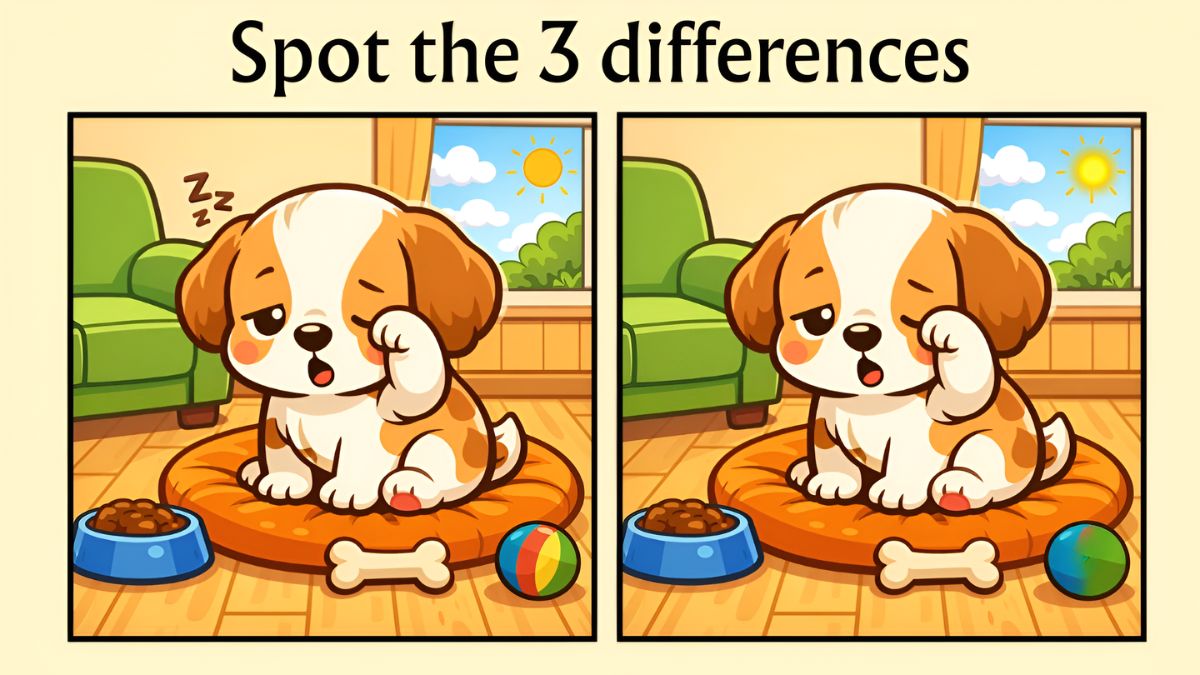
Spot-the-difference puzzles may seem straightforward at first glance, but they can be surprisingly tricky once you start the timer. The “lazy dog” challenge presents you with two nearly identical cartoon scenes: a sleepy puppy resting on a bed in a cozy room, featuring a green armchair, a bright window, toys scattered on the floor, and a food bowl nearby. The goal is simple—identify exactly three differences within just 10 seconds—but this design cleverly exploits how human attention operates.

This particular puzzle is enjoyable due to the juxtaposition of comfort and challenge. The scene evokes a sense of safety and familiarity, leading your brain to quickly categorize it as “the same picture twice” and halting meticulous comparisons. This is where the challenge lies. To succeed, you must override that initial assumption and carefully scan the images with a focused intent.
Why this puzzle feels harder than it looks
Your visual system prioritizes speed over accuracy. In everyday situations, you don’t need to scrutinize every detail of a room; you simply require the gist of the environment (such as a sleeping dog and a bright window). This efficiency is beneficial but can cause small alterations to go unnoticed in puzzles like this one.
When faced with two similar images, your brain relies heavily on predictions. Once it recognizes the overall arrangement, it automatically fills in the gaps, believing the left and right images are continuous. Under time pressure, you tend to conduct a broad scan rather than a meticulous comparison, causing subtle differences in color, number, or shape to escape your notice unless you concentrate directly on them.
Your emotional state also impacts perception. Adorable illustrations can lower analytical intensity, making you enjoy the scene rather than interrogate it. This doesn’t imply you’re “bad at puzzles”—it simply indicates that the artwork effectively engages your attention.
The brain science behind “change blindness”
This puzzle highlights the concept of change blindness, a well-researched phenomenon in perception studies. Research by psychologist Ronald Rensink and others has shown that people frequently overlook noticeable differences when their attention isn’t focused on the area where the change occurs. It’s possible to look directly at a detail but still fail to recognize the difference if your attention is dispersed.
Understanding this can be aided through the concept of feature binding. Visual aspects such as color, shape, and motion are processed through distinct neural pathways before being combined into coherent objects. In nearly identical scenes, your brain quickly binds the objects, treating them as stable. The attentional spotlight linked to parietal networks acts as a gatekeeper, permitting only a small portion of the visual field to receive high-resolution processing at any moment.
Working memory also plays a crucial role. To identify differences, you’re essentially maintaining one image in short-term memory while comparing it to the other. With a strict 10-second limit, that memory comparison can easily become fragile, especially if your gaze shifts too quickly and the details aren’t encoded strongly enough for meaningful comparison.
A fast method that actually works in 10 seconds
While random scanning may seem effective, it’s often the slowest approach. Instead, use a structured and systematic technique, even when the image is appealing.
Here’s a strategy to try next time:
- Break the image into distinct zones: top (window area), middle (dog and bed), and bottom (toys, bowl, floor).
- Compare one zone at a time from the left image to the right image without skipping around.
- Focus on “fair puzzle targets”: faces, repeated symbols (like “Z” sleep bubbles), bright objects, and high-contrast areas near edges.
- Use the flicker trick: alternate your focus rapidly between the left and right images to make changes stand out as a perceived “blink.”
- Slightly slow down your eye movements. Rapid saccades can skip details; controlled scanning allows for better detection of edits.
This method is effective because it lightens cognitive load. Rather than retaining the entire scene in memory, you concentrate on one zone at a time, which makes it easier to confirm differences.
Solution: the 3 differences in the lazy dog pictures
If you found yourself out of time—or if you want to verify your answers—here are the three changes featured in this challenge:
- The sun in the window displays additional rays in the right image.
- The ball near the bone has changed color: multicolored on the left, solid green on the right.
- One “Z” is missing from the sleeping bubbles above the dog’s head in the right image.
Notice the pattern: none of these alterations change the overall feel of the scene. The dog is still sound asleep, the room continues to be cozy, and the layout remains virtually identical. This is why your brain often wants to categorize both images as the same.
What your result says (and what it doesn’t)
If you quickly identified all three differences, it indicates strong selective attention and effective visual working memory under pressure. These skills are transferable to real-life tasks like proofreading, quality control, interface testing, and clinical observation—situations where minor discrepancies matter.
If you had difficulties, it doesn’t reflect poor vision or low intelligence. Many individuals inherently process scenes in a holistic manner, concentrating on relationships and overall meaning instead of minute specifics. In fact, this broad processing can be an asset in strategic thinking, leadership, creative ideation, and social reasoning—areas where an obsession with small details may be counterproductive.
The key takeaway is that performance typically mirrors attentional styles. With practice, you can develop the ability to switch between holistic viewing and detailed inspection, which is why these puzzles tend to feel easier over time.
Why these puzzles are still popular in 2025
In a world characterized by constant scrolling and notification-driven attention, brief visual challenges provide a low-friction way to enhance focus. They’re quick, easily shareable, and surprisingly revealing. More importantly, they teach a crucial modern skill: resisting autopilot perception.
If you aim to improve, don’t simply repeat the same puzzle type. Incorporate variations—different artistic styles, larger grids, time constraints, or “find the odd one out”—to help your brain adapt and learn flexibility rather than memorizing patterns. Consistency is key; even spending just a few minutes daily can enhance your ability to focus on relevant details.
Frequently Asked Questions
What makes the lazy dog puzzle difficult?
The lazy dog puzzle is challenging because it exploits how our brain processes visual information quickly, causing us to overlook subtle differences between nearly identical images.
How can I improve my skills at spot-the-difference puzzles?
Improving your skills involves practicing regularly, using structured scanning techniques, and focusing on specific areas of the image rather than the whole picture at once.
What is change blindness?
Change blindness is a phenomenon where individuals fail to notice significant changes in a visual scene when attention is not focused on the changing area, highlighting limitations in human perception.
How can spotting differences help in everyday tasks?
Spotting differences enhances attention to detail and improves visual memory, which are essential skills in everyday tasks like proofreading, quality control, and problem-solving.
Are these puzzles suitable for all ages?
Yes, spot-the-difference puzzles are entertaining and beneficial for individuals of all ages, making them a great way to challenge cognitive skills and improve focus.

